Monday, August 26, 2013

Journal Entry: March 28, 2013: Restoration

An old friend has worked for nearly two years to restores his childhood home on a busy street in central Tainan. I toured the interior of the home on a previous trip, just after restoration began. The house has been unoccupied for nearly 40 years. We side-stepped around crumbling tiles and edged up narrow, dilapidated staircases connecting the four levels. Overall, it was a mess. But through the rubble, I caught glimpses of its former grandeur. Features such as high ceilings, original wooden beams, and the large central courtyard were hard to miss. Much has changed since my last tour. All of the details of craftsmanship seemed to pop out. From intricate retro modern window frames, a series of sliding front doors constructed of Taiwanese grown juniper, trim on the tile work and, around entry ways, windows, and mirrors. Restoring the building to its original form has become one of my friend’s primary ambitions. Replicating the detail and the craftsmanship has proven to be painstaking and slow and process.
During my travels, I observe that many small cities in Taiwan often showcase this type of preservation. When the Taiwanese encounter old features from a bygone era, they become heartsick and transported back to that earlier era. I gaze upon a painting, the shop owner explained, “This is of life in Tainan as it existed roughly 120 years ago.” She continued, “It was a time when everything was simpler, and people were good.” The word good she used for good was guai (first tone). If the words get drawn out a bit, it’s an example of onomatopoeia. This restorative energy has caught on here in Tainan. Here are some pictures of the home, as we tour it by night.


Friday, August 23, 2013

Journal Entry: March 28, 2013


Lessons from Li Lao Shi 
I met with Teacher Li and mentioned that I want to bring my son to Taiwan for part of his grade school education. “That's good!” he said. “That's what you have to do. You're almost 40. You have to bring him along with you, so he has a strong impression of what his father did.” Then he chimes in with his joking nature, “Teach him how to earn Chinese money.”

He is joking, but he knows it is no joke, and continues into one of his philosophy raps. Such is the way of Teacher Li. “How many PhD's are there in the world today?” he queries. “So you know that a PhD doesn't mean a crap. But in this new world that your son will live in, how will people achieve value? It’s important to be able to do something that brings value. Remember my nephew? The one who was a straight-A student and went to England to study? He hurt himself and had a hard time studying ever since. Now he is training to be a chef in a famous kitchen here in Taiwan. After you graduate from school, what do you have to do?”

I've heard this particular rap a few times. So this time, on cue, I tell him the answer, “Get a job.” He replies, “Yes, get a job, so why not get a job right off, get to your goal sooner, and save yourself a whole lot of trouble?”

Li Lao Shi is an amazing character and, as a fortune teller, he knows the other side of the story. He's just waiting to see how much of the story we can piece together to create a guide for achieving the best life possible. As a fortune teller, this must be one of Teacher Li's favorite subjects. 

Wednesday, August 14, 2013

Precursor to the Taiwan Travelogue - Year of the Snake

Year of the Snake - 2013
March- April 2013

The following is an attempt to capture the experience of my most recent tea buying trip to Taiwan. I know that many of you haven't been to Taiwan. It’s a beautiful, vibrant island. Yet there remains a huge cultural gap that is not easy to navigate. People have different ways of knowing and doing, so there is a lot of room for disconnect. The tea table is a place where connection is established regardless of these cultural differences. At the tea table, we begin to understand each other, if for nothing else, to normalize our own experience. To tell a joke, to laugh, and to drink tea together; life doesn't get any better than this...

This is the result of one to two decades of work: learning, exploring, recording, meeting people, forming and maintaining relationships. This all takes time and much of it can't be rushed... at the risk of missing it.

So let us begin on a little adventure I'm going to call “gutting my memory.”

Entry into Taiwan

As I step off the plane, it’s approaching 6:00 am in Taipei, Taiwan. At this early hour, there is no need to hurry, so I buy a bus ticket headed south to Tainan, the old Southern capital. The bus trip requires two legs, with a transfer in Taizhong. Upon arriving in Taizhong, I decide to make the stop worthwhile by searching out a traditional breakfast and visiting tea friends. After the long trip filled with icky airplane food, I was starving. I can almost taste the steamed buns and fresh soy milk. I remember a great breakfast place next to a tea shop that I want to visit so I take a cab from the bus station, hot on the trail of steamed buns... and they did not disappoint. They were so good that I ate two servings, and walked around the corner to my friend’s teashop. As soon as I stepped in the shop, the room started to tremor. In the chaos I heard someone say, “Earthquake!” The shop owner started to chant some Buddhist scriptures as I felt the floor sway underneath us.  The walls swayed to and fro and the owner’s wife moved toward them to make sure that none of the expensive tea ware fell from the shelves. It was all over before it started, but what a welcome! I spent the morning selecting tea and tea ware and before long it was time for lunch. After lunch together, I continued my journey south. This earthquake was most severe in Nantou County. Well, this trip has already started out with a bang and I couldn't help but think that it promises to be a good one.

Thursday, August 08, 2013


I just found this in my journal.

This is a tea love story. Vast universes and ecosystems are experienced and discovered with each infusion. Each sip lingers, holding court in the bodies central channel, from the lower intestines to the throat and nose. It can be felt from the soles of one's toes to the neurons in the brain. We experience tea.


It doesn't say, but I wonder what kind of tea inspired this tea love poem.

Thursday, June 13, 2013

The Weight of Oolong


People often imagine me, as a tea vendor, drinking one amazing tea after another.  I do all right, but I am also often sipping from the leftover dust after bagging a few pounds of whole leaf tea.  It's best for J-TEA and if it is the dregs from high grade tea, then it's OK with me.  But once in a while, I come across a tea so alluring, that I cannot help but "test" some of the examples of fine tea, just to know what it really is.  

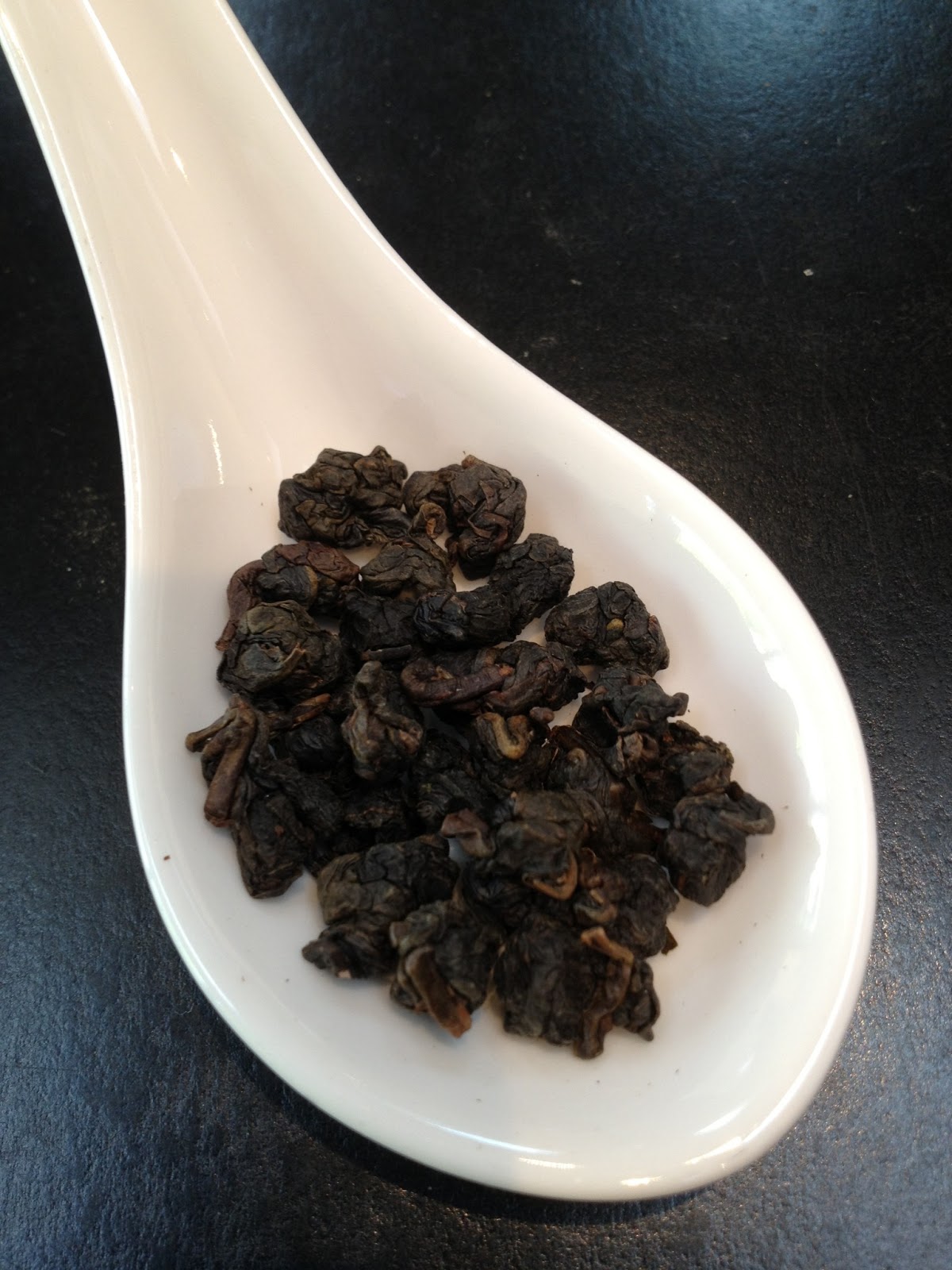
This Mu Zha Competition Winning Iron Goddess from the winter of 2012, we are calling Honorable Mu Zha, caught my eye in a recent tea packaging session.  Yes, I still package tea.  I find it relaxing.    

Since this tea is so beautiful, I had to share a few photos, in the process, brewing up some of said tea, and I guess I should taste it.

While packaging this tea, I was struck by its appearance.  The leaf roasted oh-so-dark and rolled up nice and tight, it looked more like a juniper berry than a tea leaf.  


After weighing 3.5 grams of these magical kernels and snapping a few photos, I got to business.  Hot, hot, hot.  Everything is preheated.  

This teapot, dedicated to iron goddess, holds about 6 or 7 ounces of water.  Tea steeps for four minutes, with water right off the boil. 

The results shown above: an amazing complex floral candy aroma that eventually sinks deep in the tissue where the nose connects to the face, deep into the root of the nasal cavities leaving a distinct tactile experience through nothing more than its aroma.  Starting with light smoke roast and ultimately ending with berry, after passing through a number of aromas, such as cherries, wood, sweet floral, etc. 
Really clear flavor, but extremely rich.  It almost tastes like that really good coffee that tastes like tea.  The range of flavors is broad.  Simply put, this tea is so good, I cannot believe how good it makes me feel.  
After brewing again, this time for five minutes, I am thoroughly impressed.  

The leaf, large teeth, full intact leaves, fairly consistent oxidation.

After the intensive brew conditions, there were still a portion of the leaves that were left only partially opened.


Saturday, May 18, 2013

The Unfortunate Art of Discernment

With the seeming blink of an eye, I've become an adult. At which point, I have to make a decision: Either I keep quiet or I do my best to inform people what I have learned at the risk of sounding like I know what I am talking about. This prospect does not thrill me, and I have avoided it to this point. Part of the story I have to tell is how to live your life. Or rather a version of “how to live.” I should point to my teachers. My teachers are many. Mostly because whoever teaches me is a teacher.


Another important part of the story is East meets West—specifically, Southern Taiwan and the Pacific Northwest. Here is an example. My life in Taiwan is divided into two distinct stages: before I knew how to live in Taiwan and after I knew how to live in Taiwan. People taught me how to live in Taiwan, mainly my teachers.

One of the most formative was Teacher Li. Teacher Li is still lives in Southern Taiwan today. He taught me how to take care of myself from a holistic Chinese medicine perspective. At that stage of my life, I was like a rubber band. I could go very far in another direction, trying things for several months before deciding if they were good for me or not. I changed my diet according to his suggestions, and this is really touching on how to live here. Knowing how to live is about knowing how to enjoy your life. Diet is so much a part of life’s enjoyment. I have met people who claim not to care about the food they eat. This is a problem. Teacher Li would say, “Give them the leftover dog food.” Ah, but you don't want leftover dog food? So there is some level of discernment. Good - that is the point.

How to Live” Tip of the Day: Constantly learn about food.  

Thursday, May 16, 2013

The Spirit of Taiwan...


In a song by 張雨生 Zhang Yu Sheng (ZYS) called 我的未來不是夢。”My future is not a dream.”

你是不是像我在太陽下低頭
流著汗水默默辛苦的工作
你是不是像我就算受了冷漠
也不放棄自己想要的生活。
你是不是像我整天忙著追求
追求一種你想不到的溫柔。
你是不是像我曾經茫然失措
一次一次徘徊在十字街頭。
因為我不在乎 別人怎麻說
我從來沒有忘記我
對自己的承諾
對愛的執著
我知道我的未來不是夢
我認真的過每一份鐘
我知道我的未來不是夢
我的心跟著希望在動

I will attempt a translation:

Are you like me? Under the sun with your head hung low?
Sweating as you toil silently in your hard work.
Are you like me, often the recipient of indifference or a cold feelings, but refusing to give up on the life that you want for yourself?
Are you like me, busy the entire day pursuing...
Chasing after a gentle kindness, that you can't even comprehend.
Are you like me, having experienced great loss?
Time after time, hesitating at the busy intersections.

Because I don't mind what others say, I've never forgot myself.
The promise that I made to myself
To keep a grasp on love.
I know that my future is not a dream.
I earnestly live every minute of life.
I know that my future is not a dream.
My heart and my hopes create my action.

I've been familiar with ZYS for several years. He died in a car crash in 1997, but his music lives on. After my first stay in Taiwan, a dear friend suggested that I take some ZYS music home with me in order to improve my Chinese language skills. I wouldn't have predicted at that time - nearly 16 years ago - that I would still be moved by his words today.

Taiwan's Buddhist population is about 35%. As such, Taiwanese culture is heavily influenced by Buddhism. With lyrics like, “I earnestly live every minute of life” making their way into popular songs, we can see its influence.

Another very Taiwanese aspect of this song is the repetition of, “Are you like me?” with the common experience mentioned after it. It is an all-inclusive statement, unifying people by their common experience. The energy of “we are a group of brothers and sisters” is very Taiwanese.


Wednesday, May 15, 2013

East and West: A Convergence of Cultures... in Eugene, Oregon

The Dalai Lama visits my home town; wow, the people of Eugene are lucky indeed! It was a great honor and privilege for Eugene to host the Dalai Lama as a guest and personally to hear his message. This would never have happened if it were not for the persistent work of key individuals who were able to convince him to visit Eugene. This visit was the culmination of a a ten-year effort, during which time he was less than excited about the prospect of visiting Eugene. Why not just visit a bigger city? Why not Portland? These were questions that the Dalai Lama himself was asking. Special teahouse sources have indicated that he would have never visited Eugene if it were not for the work of Lady Palmo, who not only had the ear of the Dalai Lama, but insisted that he visit Eugene. Let me tell you that many Eugenians are grateful for your efforts, Lady Palmo. Being born and raised in Eugene myself, I was very moved by the Dalai Lama's visit and I feel like his visit improved the energy of Eugene.


Though the costs associated with bringing the Dalai Lama to Eugene were exorbitant, the University decided in the beginning that the tickets for the event would be very reasonable. They made a portion of the tickets free to students, and offered the remaining tickets to the general public at $20 each. There was no VIP seating, no higher priced tickets for special seating and so on. This move was very democratic and very Eugene. The tickets went fast, selling out within an hour of their release. I was only able to get tickets through the generosity of a teahouse fan. The teabike was at the University of Oregon Street Faire on the afternoon of the event, but my trusty crew was able to cover long enough so that I could slip away to listen. Seeing him, I was filled with emotion. Somehow, just knowing that there are people like His Holiness is enough. As soon as he entered the room, waves of energy—as if a healing presence—filled the air.

Later, I had the opportunity to ask one of my Chinese friends if they were able to attend the lecture given by the Dalai Lama. “No way,” he responded. He went on to inform me that at one U.S. university, the Dalai Lama came to speak and many students from China went to listen. As a result, China nullified any degrees earned from the university. In the eyes of China, all of the credits were void. “Since he came here, we are all very scared.” Who knew Chinese nationals have so much to lose as a result of a visit from Tibet's exiled religious leader. Yet another interesting perspective revealed at the teahouse.  

Plan, Hope, and Visualize

What happened in the teahouse today?
We are in the process of consolidating our inventory in anticipation for the upcoming shipment from Taiwan. Organization is a constant aspect of our work at J-TEA.

Last week we had a great time at the University of Oregon Street Faire. We were very busy Wednesday, Thursday, and Friday. Many students were happy to try our iced tea selections, as the bike is mostly an iced tea affair. The weather couldn't have been more cooperative. When selling iced tea, hot weather is an essential component.


As many of you may know, my first child will be born any day now. Today a friend came into the shop and asked if I am ready for the future, referring the upcoming birth of my child. To which I responded, “How can one be ready for the future?”

His response, “You can plan; you can hope; you can visualize.”

There you have it: Plan, hope, and visualize. This is my lesson for the day.   

Friday, April 19, 2013

J-Tea: The Story Behind Our Name

People often ask, “What does the ‘J’ stand for in J-Tea?" In fact, it doesn't stand for anything. It’s simply our name. In the process of conceiving a name for the tea company, we created lists and lists of possible names. Yet, none stood out. During this time, my grandmother was visiting from Chicago and I asked her opinion. She is a poet and for long as I can remember, she has recited a poem at Thanksgiving that includes all of the family members and something special about them. I remember thinking that she might just have the answer to the name quandary. Upon asking, she cocked her head, tilted and looked slightly upward, much like I've seen a terrier do when you ask it if it wants to go outside. "J-TEA," she said. My grandmother, in all of her wisdom, had spoken. The name had a nice ring to it and the rest is history.


People often think that the “J” in J-Tea signifies my name, Josh. It’s true that I am the “J” behind J-TEA, but J-TEA is an entity of its own, with its own name. On a side note, people who don't know my name often call me Jay. At first I thought it was funny, but now I just go with it. Sure, you can call me Jay. In fact, call me whatever you like; just don't call me late for drinking tea.