Wednesday, April 02, 2008

Gong fu cha; easy as 1, 2, 3....... 6, 7, 8, 9

This is a question that often comes up. Most often, people think that this size pot will only make enough tea for one. This is a guide to the basic outlines of Gong Fu tea brewing, as well as a demonstration to show the amount of tea that a small pot will produce. Just remember, it is not the size of your teapot, but how you use it, that is most important.

The setup

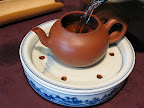
Heating the pot. Fill your pot with boiling hot water and let set for a few moments. One tea master told me that the pot is properly heated only when the lid handle is hot. If you fill your pot with boiling hot water and wait about a minute, then touch the lid handle of the pot, it should be hot. This is a good start.
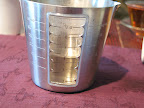
This is a 6 ounce pot.

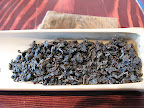
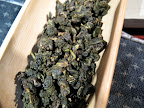
The leaf, compliments of J-Tea. Competition Winner Mu Za Iron Goddess (Second Tier) Spring 2007

15g of tea

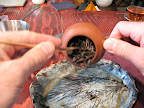
The leaves should fill the pot about 1/3rd of the way.
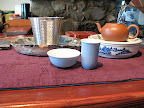
First infusion-30 seconds-no rinse. I typically will not rinse the tea, especially when it is of such a high grade.

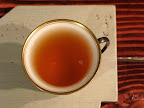
The first infusion yields about 5 ounces of mouth watering tea.
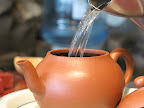
Moving right along to the second infusion-35 seconds

I love teapots!

The first two infusions combined makes just shy of 10 ounces of tea.
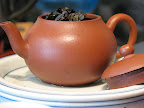
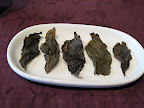
Now the leaves have unfurled and they are expanded enough to just fill up the pot. I think I might have used a tad too much. In general, when the leaves have expanded, they should fill the pot, but they should be fluffy and giving instead of resistant to the touch.

Third infusion.

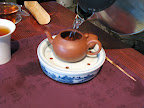
Pouring water over the top. This action has a number of applications. First, it is fun! Next, it cools the temperature of the pot. It treats the pot adding to the brilliant patina, and it can act as a natural timer. When the pot is again dry, a certain amount of time has gone by. This time will change with pots and with the temperature of the water.
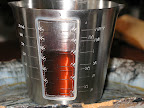
The third and fourth infusion combine to yield just over 8 ounces of tea.

The fifth and sixth, the same, and...

the same for the seventh and eighth

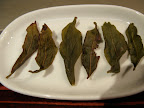
Empty the leaves.


Rinse the pot.

Admire the handiwork.

Summary:
All in all 15g of dry leaf yielded 34 fluid ounces of tea. Brewing tea in the traditional method according to heavy tea drinkers taste, 1 ounce of tea yields 8 cups of tea. If I were to do this demo again, I would do it with a lesser quantity and quality tea. Quantity, because I actually think I used too much tea as it was poping out of the pot after the first two infusions. Quality, because putting the tea into that measuring cup made it less tasty.

Tough Questions

Last weekend I did a tea tasting in Bend, OR. After the tasting, my partner stated that I was only providing about 40% of the information when answering questions. I thought that this was an interesting observation. It also reminded me of my friend in Taiwan that used to ask me, "Have you learned all there is to know about tea yet?" to which I would always answer, "no". Most people think that tea is not complicated, and it is true. Tea is not complicated, but it is not easily understood. Often times, people in my shop will say, "Puer, what is that?" My answer to this question takes about 5 to 15 minutes. There are so many ways to answer this question. My answer usually starts like, "Puer is its own category of tea..."

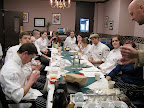
Tea Tasting at the Lane Community College Culinary Arts program (03/05/08)

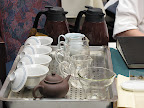
The setup


This girl can rap. Check it out! http://www.myspace.com/brastrapz

This was one of the tastings that I learned the most from so far. This group had some really tough questions.

Tea is Healthy!

Research conducted at Oregon State University found that freshly brewed tea contains 10 to 100 times more antioxidants than bottled teas. If you want antioxidants, drink freshly brewed tea.

Tea is just as effective as water in helping keep people hydrated. It is a common myth that tea or any other caffeine-containing beverage will cause a loss of body fluid and negatively impact the body's hydration level. Scientific evidence simply does not support this belief. UK experts found that drinking three or more cups of tea a day is as good for you as drinking plenty of water and it even helps to protect against heart disease and some forms of cancer. Drinking tea can give your mind a gentle lift that can help you focus. Moreover, unsweetened brewed tea is a perfect beverage to use as part of a weight management diet or lifestyle.

Tea demo at the University of Oregon

  The class was about Chinese food and culture. Ah, it made me miss the days in Taiwan, when I was just spending a great deal of time adjusting to the culture. In order to acclimate myself, I would spend the first three to five hours of each day eating and drinking at a very leisurely pace.
The professor, Ina Asim, graciously invited me to give a tea demonstration and allow the students to taste several high end oolong teas.  
 I am not sure why I used this set up, but if I had to do it again I would use several small brew cups as is done in the tea competitions of Taiwan.
 
Posted by Picasa

 
Posted by Picasa
Professor Ina Asim and I.

Saturday, March 29, 2008

Dong Ding Gui Fei Mei Ren


Formosa Oolong
Formosa Oolong is a specific category of oolong also commonly known as “Oriental Beauty”, “Bai Hao Oolong”, “Silver Tipped Oolong”, “Dong Fang Mei Ren”, “Pong Hong Te” and now “Gui Fei Mei Ren”.

How does the Formosa Oolong group get their wonderful flavor? An interesting article in the Taiwanese magazine gives an account:

In the months of May through July tiny insects called leaf hoppers are at their highest concentration. During this time, tea farmers throughout Taiwan make preparations for their summer harvest of Formosa Oolongs. In the past, pesticides were used to discourage these little buggers, but in recent years the farmers have hoped that their crops are well attacked. It was discovered that the more highly concentrated the leaf hoppers, the more flavorful the tea.

The leaf hoppers became a welcome pest, adding flavor to the tea throughout the island. Through several hundred if not thousands of years of evolution, the fresh tea leaf has developed a self defense mechanism. The threat caused by the leaf hopper resulted in abnormal metabolic rhythms being produced by the plant which in turn caused some sort of chemical reaction that results in “multiple tea polyphenols” (the powerful antioxidant found in oolong tea) and tea tannins. These polyphenols and tannins in turn attracted the leukoplakia wax spider, a natural predator of the leaf hopper. A full grown leaf hopper is no bigger than a fruit fly. It is as small as a spec of dust. They have a sharp beak poker mouth that resembles a shortened mosquito snout. The leaf hopper uses this poker to suck out the nutrient juices of the fresh and tender leaves of the camellia sinensis, or tea plant. The leaf hopper threatens the sprout of the fresh leaf which looks like a toothpick. In a controlled experiment, researchers found that when artificially replicating the attack of the leaf hopper in a lab, the tea plant responded similarly, producing the same abnormal metabolic rhythms. But the degree to which the chemical reaction occurred was far less. When researchers tasted both teas the results showed clearly that the tea bitten by the leaf hopper was significantly sweeter than the tea that was artificially attacked. The conclusion of the research was that the classic honey taste associated with Formosa Oolong comes from the leaf hopper actually sucking from the tea sprout.

How did Dong Ding Gui Fei “Leaf Hopper Oolong Tea” come to be? The story begins with an earthquake that occurred in September, 1999, in Nantou, Taiwan, ---7.6 on the Richter scale This earthquake is often referred to as 9-2-1. Nantou County is considered one of the safest natural environments. The island of Taiwan is riddled with earth quakes, but natural Utopias exist. Many moved to Nantou with the idea of being safe. It is an area much like Eugene, a great environment and very close to the mountains. Yet, the epicenter of the devastating earthquake of 9-2-1 was in Nantou. Needless to say, the land was greatly transformed. Many roads were destroyed. There was a period in which the tea fields were unattended to. During this lack of attention, leaf hoppers were abundant. When the reconstruction took place, special care was given to the development and nurturing of the tea farms. As a result of this lack of care followed by some special care, the Dong Ding Gui Fei of 1999 had an exceptional honey taste. Since then Gui Fei has became an immensely flavorful and highly sought after Formosa Oolong.

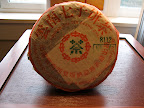
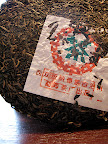
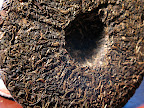
Small Puer Cake


Wednesday, October 31, 2007

J-Tea Leaf House Grand Opening!

J-Tea Leaf House Grand Opening
J-Tea’s Tea Leaf House will open on Wednesday afternoon, July 25th at 2778 Friendly Street in Eugene.

J-Tea is the source for some of the highest quality hand crafted tea available in the world. Tasting this tea is a new experience. The J-Tea Leaf House will feature award winning loose tea leaf hand crafted Oolong tea, Puer tea bricks, teapots, tea cups, tea sets, other tea related tools. Since 2004, the J-Tea brand has been sold in over 30 specialty tea shops throughout the U.S. (including at the Asian Market and Provisions in Eugene).

Tea tasters are welcome although tea will not be served by the pot or by the cup.

The J-Tea Tea Leaf House is modeled after Taiwan style tea leaf vendors. Patrons are welcome to participate in tea tastings as well as purchase loose leaf tea that can be taken home for personal brewing. Tea tastings for groups are available by request.
My thanks to everyone who came by to visit the J-Tea Leaf House on Friendly Street. I very much enjoyed meeting you and look forward to seeing you in the future.

Notes on the J-Tea Leaf House schedule
Currently I am out of town on a tea selling excursion. I will return to Eugene on September 16th and I will be open through the 19th. On the 20th I am traveling to Taiwan to get more tea. I will return on the 10th of October. The tea house will be open from October 10th until December 24th. On the 27th of December I am going back to Taiwan to but tea from the winter tea harvest.

Regular hours
J-Tea Leaf House hours on most Mondays through Fridays are from 11am to 6pm. We are also open on some Saturdays and Sundays from 1pm to 6pm (call 285-8997 for more information).

Notes on caffeine
J-Tea does not sell any herbal teas. All of the tea sold by J-Tea is a camellia sinensis. As a result, many people have been asking about caffeine. Below is a list of caffeine content in particular beverages: Espresso, 1-oz shot 40 mg
Coca-Cola, 20-oz bottle 57 mg
Red Bull energy drink, 8.3-oz can 80 mg
Brewed coffee, 12-oz cup 200 mg
Mountain Dew, 64-oz Double Big Gulp 294 mg
J-Tea type Brewed tea, 8-oz cup 50 mg


Of course, the amount of caffeine in a brewed cup of tea depends on the kind of tea, the condition of the leaves and the amount of leaves used.

Notes on brewing
Ideal water temperature –
Wen Shan Bao Zhong, Oriental Beauty and Formosa Oolong – 180-200ºF
Other oolongs – 190-200ºF
Puer and Iron Goddess – 200-212ºF

Brewing in a Mug
Tools: your favorite mug
Method: Start with one teaspoon of tea and alter. The key is to experiment and discover your individual taste.
step 1 – put one teaspoon of tea in mug
step 2 – add boiled water, allow tea leaves to unfurl
step 3 – drink tea off top, leaves will settle on bottom
step 4 – rebrew up to 3 times (brew time 3-5 minutes) or until tea is no longer at desired strength
Yield – up to 4 cups

Simplified Gong Fu Tea Brewing
Tools: small clay pot/ guy wan, small tea cups, pouring pot
Method:
step 1 – boil water, warm tea pot and cups
step 2 – use up to ¼ pot tea leaves, add boiled water and pour away first brew to rinse leaves
step 3 – add boiled water and steep 30 seconds
step 4 – repeat steep adding 5 seconds each time
**steep shouldn't exceed 1 minute

Yield – 5-10 infusions

Not so distant future
This fall I will be offering a variety of high quality and exceptionally prize winning teas. Please stop by the J-Tea Leaf House to check them out.

Best Regards,

Josh Chamberlain
J-Tea Leaf House
2778 Friendly Street
Eugene, OR
97405

To unsubscribe profile: click here

©2007 J-TEA International. All rights reserved. Last updated 9/15/07 . Questions or comments, e-mail help@jteainternational.com


Thursday, October 25, 2007

J-Tea October Newsletter

J-TEA International. October 2007

J-Tea News
The J-Tea Leaf House offers tea that I have personally selected from small independent family farms. These are farms that I have direct relationships with.

Now it’s Oolong time all the time.

I am back from Taiwan. It was a great trip! The J-Tea Leaf House offers tea tasting, over 43 varieties of Oolong tea, 7 varieties of Puer tea, and other Chinese tea including Yunnan Golden Tips, as well as a wide variety of tea ware. The tea list is always growing. Fifteen new Oolongs are on the way here from Taiwan. Also I will soon receive some great new tea brew ware and some fantastic ceramics.

Trip Highlight
I charcoal baked my first batch of Oolong! Charcoal baking is the way that Oolong tea was traditionally roasted. This tea baking process is one that is kept secret and is often mystified to confuse tea vendors and producers. If everyone knew how to improve tea with this method, those that are considered baking masters would be out of work!

The function of baking tea is to preserve its shelf life, and to bring out some of the fruity or citric flavors of a tea. Actually, the process is not all that complicated, but it does take a bit of work and some very specific equipment. Here’s how it works:

First we filled a cement drum with 80 lbs of charcoal made from the Long Yen (longan) tree. This is a fruit tree that produces fruit a little bit similar to apricots. The great thing about charcoal baking is that the flavor of wood is absorbed into the tea, thus it is very important as to which wood is used to make the charcoal. The Long Yen wood is considered some of the best to make charcoal for baking tea.

The charcoal came in large chunks so we used a hammer to break it up into small pieces. Next, we compressed the charcoal by tamping it down into the cement drum. After igniting the charcoal at the center with a blow torch (a somewhat modern intervention) we covered all of the charcoal with about 2 inches of Long Yen charcoal ash. This acts as insulation and prevents the tea from being directly exposed to an extreme heat. The thickness of this ash can be adjusted depending on the charcoal heat.
This fire burned for 5 days straight. Each batch of roasting takes anywhere from 2 to a few hours, so several batches of tea can be roasted from this one fire. Roasting time depends on the heat of the fire and the degree to which one desires the roast.

A bamboo woven rung sat above the cement drum. In the rung is a metal screen and the tea sat on this metal screen. The screen was big enough to hold about 7 pounds of tea, and the rung held the tea about 15 inches above the fire. After the tea was spread evenly on the screen a small portion of tea was scooped out from the center, so that there was no tea in the center of the screen. This was the hottest area of the fire. It is important to keep tea off the hottest part of the fire.

I was helping with the roasting process for 2 days when my teacher posed the question, "Would you like to roast a batch of tea yourself that you can take back to America?" Of course I said “Yes”. What an experience!

I selected a Mt Ah Li Mi Xiang Oolong. This is a tea that has a substantial body and a sweet aftertaste. After placing my tea on the fire, an unpleasant smell was released from the tea. This is common when the tea is first placed on the fire. The timer was set for 15 minutes. Every 15 minutes I removed the tea from the fire and stirred it through a flipping motion so that all of the surface area of the tea was evenly exposed to the fire. Again after each stirring, I scooped out the center portion of tea. After about 45 minutes the tea released an incredibly fragrant smell. Toward to end of the baking process, time between stirring was reduced. After 2 hours and 30 minutes, the tea smelled excellent. I took some of the tea and brewed it and decided to let it bake a bit longer. Then after a little while I tasted the tea again, I decided it was ready, and I removed it from the fire and placed it in a bag.

Days later I tasted the tea again and it had a different even smoother woody flavor that had slowly developed in the tea. When my tea teachers tasted the tea, they both nodded their approval. It was a success!


J-Tea Leaf House Hours
The Teashop is open everyday except Friday and Saturday. Hours are from 11AM to 6PM

J-Tea Leaf House Location
We are located at 2778 Friendly St., across the street from the Friendly Street Market.

Come by to see our new selection of tea and tea ware.

©2007 J-TEA International. All rights reserved. Last updated 10/14/07 . Questions or comments, e-mail help@jteainternational.com