Saturday, June 14, 2014

Blue Tea

The first time I heard the term “blue tea”, I thought it was totally bogus. A UO professor asked me if I'd ever heard of this kind of tea before. When I said that I hadn't, he offered to bring me a copy of a book that he had just brought back from Mainland China. Flipping through the book, I was shocked to see that the tea the author classified as blue tea was oolong. I dismissed it as a fluke and hoped I would never come across the term again. If only I had been so lucky...

I have one request of the tea world. Let's agree not to call oolong blue tea. More and more, I see books and magazine articles referring to oolong as blue tea. We have to put a stop to this. I am slightly color blind, and maybe for that reason, I want things that are called blue to really be blue, or sad, and oolong is neither of the two. 青 or “qing” is one type of oolong. Qing can be translated as either green or blue. This category of oolong is what we at J-TEA refer to as “green oolong.” We call it green oolong, well, because it is green. But maybe, because qing can be translated as either green or blue, then maybe it could be called blue tea. But in my mind, for the reason stated above, and because qing is only one type of oolong, it should not be called blue. To leap from this one mistranslation, to calling the entire category of oolong “blue tea” is absurd.
An example of qing oolong tea

When I was trying to make sense of this nonsense, I reached out to the online tea community. “Tea enthusiasts, what is this nonsense about calling oolong blue tea?” It was here that I learned that there was some genius who thought, because other tea categories were named by color, that all teas should be named by color. This makes sense right? I mean white tea is not white, and black tea is not black, unless it is Lipton, which uses food coloring, so why can't oolong be blue? I guess we could if we really want it to be.


But do we? Do we want to be this lazy in our approach to classifying tea? Are we really going to call roasted oolongs, amber in color, the traditional color of oolong, are we going to call this blue? Formosa oolong's or eastern beauties; intoxicatingly translucent red, are we going to call this blue? Traditional iron goddess of mercy, a dark rich ruby red, should we call this blue? I must protest. I must find a way to put a stop to this. There is such a wide range of oolong teas, and it makes no sense to give them the color code blue. Classifying all oolong as blue is too lazy, and classifying qing as blue is a mistranslation. So it looks as though I have another fight with the tea world's status quo. Let it be known that I am fighting for transparency, not obfuscation. We can all say oolong, weather you spell it oolong or wu long. So say oolong like you mean it, like you are proud, and it won't be too long before everyone knows this amazing category of tea by its proper name.  

Aged 1986 Dong Ding Oolong, looking anything but blue.

Thursday, June 12, 2014

The Psychology of Tea – Laughter and Appreciation


The psychology of tea is stuck in my head. On reflection, I have a lot to say about this subject. This is a huge topic simply because there are so many psychological benefits of tea. There is no doubt in my mind that tea has many subtle benefits to health, both physical and psychological. Just today, taking my first sip of tea, I am revived. “I can make it. I will overcome my obstacles. I will achieve my goals. Life is good. Gratitude.” All of this came to mind the moment the tea touched my lips. This is the profound impact of tea.

Psychology in a nutshell... our interpersonal relations, who we get along with, why we get along with them, how we get along with ourselves. Why do we dislike the people we dislike? What are our obstacles? How do we overcome them? What is our outlook? People are difficult to understand. Even understanding ourselves is difficult, let alone understanding others.

Tea has an introspective energy, shedding light on the essence of who we are. This provides the opportunity for personal growth.

Many people have described before how, for example, by setting aside a time for tea for the whole family, when the whole family comes together to drink tea, improves familial relations. This is akin to eating meals together as a family. It is a way to spend time together. On multiple occasions, more than I can count, and more than I am even aware of, tea has facilitated with a feeling of togetherness, bringing people together, establishing connection, and a sense of well being.

“If I've taught you one thing, it's how to pivot.” Martin told me this after I conveyed to him the following experience. I was conducting a tea tasting at The Kiva. Several teas were in the line up, steeping in the Jian Ding Bei, professional cupping set, and decanting into colorful teapots. One steep at a time, doling out the samples, until that infusion is used up. Then I steep the leaves again. This process is repeated several times until the leaves have lost most of their luster. I only brew one infusion at a time, so there is just a little bit of tea sitting in the colorful teapots at any given time. I do this, so that when I pour the sample into the porcelain sample cup, the tea is hot. This works pretty good, but on this particular day, business must have been slow. I'd been there a couple of hours, steeping and re-steeping, and my mind was starting to wander. A man approached and I cordially offered him a taste of tea. Upon tasting the tea, the man complained, “This tea is cold.” Something about his attitude, maybe it was his lack of appreciation, was less than endearing. So I answered, “No, the tea isn't cold. You are late.”

As soon as the words left me lips, my core was vibrating with a sound and sensation similar to that felt when sitting at the base of a huge waterfall. This was Martin's laughter. Uncontainable and wild, not in bursts, but more like a lion's roar.

I remember feeling afraid that I would forget things about Martin, but I can hear it as clear as the day we were sitting on his sailboat and I told him this story. He liked my story. “That is a pivot!” he exclaimed. This is the psychology of tea. And it is true, the pivot, he taught me well.

感恩 


Monday, June 09, 2014

Tea House Takeover - Josh Answers Questions About Tea

We recently had a group of special visitors from So Delicious Dairy Free take over the tea house for a private tea class. This was fun for several reasons, but one of the fun things was hosting a class for seventeen enthusiastic food people. They were very interested in learning about tea.
I asked the group to give us a list of questions at the beginning of the class so that I could address the questions as we went. Below, I've included a list of the questions and some answers.


What are the temperatures and times for brewing different teas?
Let it be known that my favorite way to make tea is in the small unglazed Yi Xing tea pots. This brew method is commonly known as “gong fu cha”. I use these pots for oolong and puer. This brew method is outside the scope addressed in this class. We used what I refer to as a benchmark brew method. The teas brewed are: Green Spring, Charcoal Dawn, Eugene Breakfast, Scholar's Mountain, Cooked Kilo Brick, Iron Goddess of Mercy, Eastern Beauty Twisted Leaf, and Starry Night.

We used the same brew method for each tea. Four grams of tea, water right off the boil (210 degrees Fahrenheit), steeped for two minutes in ten ounces of water. We used the Forlife infuser and a twelve ounce glass teapot to steep these teas. At the time of this blog post, almost all of the teas we sell at J-TEA can be brewed this way. We wouldn't want to brew Japanese green tea this way, but we do not currently have Japanese green tea on hand. Using the same method for each tea simplifies the process. One of our goals is to make tea brewing easy for people new to tea. After tasting the tea, you have a benchmark, or a general idea of the teas characteristics. Depending on how you like this infusion, you can adjust make some adjustments the next time you brew. If you like the taste of this infusion, great! If it is too bitter, you can either reduce the water temperature, or reduce the steep time. If the tea is too strong you can either reduce the amount of tea used, reduce the brew temperature, or reduce the brew time. If the tea is too weak, you can either increase the brew time by one or two minutes, or increase the amount of tea used. After brewing for two minutes, we steeped the tea again for four minutes. Remember, with high quality tea it is possible to steep the tea several times for multiple infusions.


Do / can you grow tea plants here?
The answer is yes. Many of you have tried our Minto Island Farm tea. This is all grown in Salem, Oregon, just one hour north of J-TEA. We also have several tea plants living at the J-TEA tea house that survived the great freeze of 2014. These plants are hearty and are growing in popularity.

What is the process of processing tea, from plant to package?
This will vary greatly from region to region. It will also vary greatly depending on what tea the farm is trying to produce. This subject is a bit dry and there are a variety of books and articles devoted to it. I'd say that the main flaw with everything written about this that I have seen is that they often do not cover the extensive amount of variation in that can occur within any particular process. Imagine a wine master making a pinot noir. There are infinite variations in the process that can occur depending on the variations that exist within any agricultural product. If you want to learn more about this you might check out Wikipedia's tea processing page.

What are functional teas?
Functional teas are teas that are meant to cure. These teas are generally herbal and have specific medicinal benefits. A good example of a company that produces functional teas is Traditional Medicinals.


What causes tea euphoria?
L-Theanine combined with caffeine. This is what Geoffrey Norman has referred to as “happy juice.” Tea makes you happy, there is no doubt about it, and the better the tea, the happier it can make you. Another common tea term is “tea drunk.” Tea drunk or “Cha Zui” is the result of drinking too much tea. It really has a euphoric overtone and has a similar feeling to being a bit high. But generally this over consumption of tea is not viewed as healthy and from my experience, it's fun to experience when you first start getting into to tea, but over time, as one gets further and further down the road of their tea existence, this feeling becomes less and less appealing. Tea is a good thing, but like all things, moderation is key. The amount of tea one can drink in a day will vary from day to day. I find that if I have enough rest and eat three good meals, then I can drink more tea. If I am not taking care of myself, then I often feel like drinking less tea. You can pay attention to the way you feel regarding tea. If you feel like drinking more, it is ok to drink more. If you feel like drinking less, just drink less. 


What is tea culture in other countries vs. US tea culture?
US tea culture is in its infancy, but it is growing fast. One of the main differences is that in countries where tea culture is strong, such as Taiwan, China, India, and Japan to name a few, tea culture is very old. Having been around for an extended period of time creates depth. There is a popular saying in Taiwan, “If I am not in the tea house, I am on the road to the teahouse.” The people that say this are basically saying that they live within tea culture. They don't have to be drinking tea at any given moment, but they have tea in their heart and they are living in a way that is profoundly impacted by tea. Tea is on the mind all of the time.

Much of US tea culture is very commercial. Much of the tea sold in the US has perfume added. Pick up a package of tea in your local super market. Read the ingredients. If you see “natural flavors” listed, don't buy it. These flavors are not good for us. Natural flavors are chemically synthesized in a laboratory. They are artificial; not real food. The only reason to add anything to a tea is that the tea quality is lacking. Much of the US tea culture is focused on selling tea regardless of quality.

We'd like to thank So Delicious Dairy Free for creating this private tea class. We would also would like to thank them for their great questions. It is was a good time drinking several types of tea. I will now start boiling water to brew up a pot of oolong tea to help me think of the topic of our next blog post. Until then, keep sipping great tea!


Sunday, June 08, 2014

What is oolong?


Widely defined, oolong is the range of tea between green tea and black tea. This is a broad range of tea. Ranging from 11% oxidization for the greenest oolongs, such as Wen Shan Bao Zhong, and then going all the way to 70% oxidized, for the eastern beauties and some iron goddesses. There is also aged oolong, which is further oxidized after processing, so it is often referred to as “post oxidized tea.”
Oolong is complicated and, for the most part, is not well represented in the U.S. Generally a tea shop will carry one or two oolongs generally not of very high quality. So, as a predominantly oolong focused tea purveyor, one of our constant objectives has been to redefine oolong to the consumer. We do this by getting people to taste high quality oolong.

Sometimes we even go so far as using stall tactics when offering samples. When asked about what kind of tea we are offering as a sample, we wait until the person has tasted the tea. That way they can come to their own conclusion about the tea, rather than judging it based on a name. Then we say... It's an oolong. Surprise! You like oolong! It is true, we are confident that you like oolong tea, you just might not know it yet.

Meaning that if you do not like oolong, it is probably because you have not had a good one, or it was not prepared well. Either way, this is a sad state of affairs. But, it is also why we will continue to toe the party line, dousing the nation with amazing oolong tea. We've got oolong way to go, but we've made it J-TEA's mission to expose everyone to amazing oolong tea.


Saturday, June 07, 2014

The Psychology of Tea


The psychology of tea is such a hot topic in Taiwan right now. With psychologists as parents, I've tried to write on this topic previously. He Lao, a friend and tea teacher, mentioned to me that people have written about the psychology of tea, but everything written so far has been a bit shallow. “They just say things like: having a ceremony makes you feel calm, and that this type of tea has this kind of effect and so on,” he begrudgingly remarked. Keep in mind that when He Lao is speaking of tea, he is not talking about herbal tea and he is not suggesting that we achieve some type of altered psychological state by drinking a hallucinogenic tea.

He said, “What we need are some real scientific findings or opinions on the psychological benefits of tea.” I explained that I tried to get some of these answers from my parents, two exceptionally qualified psychologists. Unfortunately, this did not work. Why is a psychologist going to talk about why tea is good, unless they have a vested interest? When Martin was alive, I tried to get him to talk about tea and he wouldn't let me pin him down on anything. This was insightful in of itself because I knew that he would have done practically anything to help me and my tea business. But he wouldn't let me say that he said anything regarding “the psychology of tea.” The message was loud and clear. Any psychologist worth his or her salt would not endorse a product, no matter how good it might be.


So I have decided instead to focus on the psychology of tea as I know it: buying tea, doing tea business, and learning about tea in Taiwan as well as how to live your life. If you want to live well... drink tea.

Thursday, June 05, 2014

If I'm not in the tea house, I'm on the road to the tea house.

Taiwan is a country rich with tea culture. It is a place where it is not difficult to find yourself surrounded by tea and tea paraphernalia. It is a world in of itself, and stepping into this world can be as vast as jumping into the ocean. This world is commonly known as “The Tea World,” and it’s made up of tea people. These are the people that eat, breathe, drink, and live tea. Sometimes they are tea vendors or they sell tea ware, maybe they are artists who have a tea room. Or they are involved in tea production such as growing tea or roasting tea. Nonetheless, tea is very important to them and it plays a major role in their lives.

I remember when I first got close to the precipice that is the divide of the tea world. I was warned...“Be careful.” Many people have thought it would be fun to play with tea, only to fall into the vastness of the tea world. Once you fall in, it is difficult to get out. As I've seen time and time again, people have invested most of their time, energy, and finances into tea. Once they get in deep, they truly are in for life. It is not a bad thing. It is just something that with will change one’s life. It is not something that happens at once, but it is the beginning of a new path. Often, this path leads to many unexpected adventures and opportunities to learn.


The depth of feeling that exists in the tea world of Taiwan is profound and it has been my luck to know it as I have. With this trip, the journey continues. 

Wednesday, June 04, 2014

A story of Mina in Taiwan...

Mina is from Japan. Every day she walks out of her flat into the alley. She sits down for her breakfast and the old women tell her how pretty she is.
“You look very pretty today!” Every day, they tell her. And she wonders why they tell her this. Tomorrow? She thinks, will they say I am pretty again tomorrow? In Japan no one ever told her how pretty she looks. Especially not every day. She wonders if it is because she is Japanese. She wonders if tomorrow they will still think she is pretty. Though she has doubts about their sincerity, she accepts what they say, and secretly, it makes her feel good.
Looking at this cup of tea, I think: “This cup of tea looks delicious.” Before long, I find myself telling each cup of tea that it looks delicious. Every day, I look at the tea and say to it, “You look very delicious. This tea is good. This tea is delicious."

When you look at your cup of tea, tell it how it is. Say, “You are a wonderful cup of tea.” We taste the tea every day, but the taste sometimes differs from what we say. The real flavor, differing from the perceived flavor, is more beautiful because it is real. This connection to reality is more important and resonates with us on a deeper level. So even though, sometimes after telling the tea how wonderful it is, upon tasting the tea we find it to be bitter, or strong, or light, this connection to the reality is more beautiful to us than any perception of tea.

Saturday, May 31, 2014

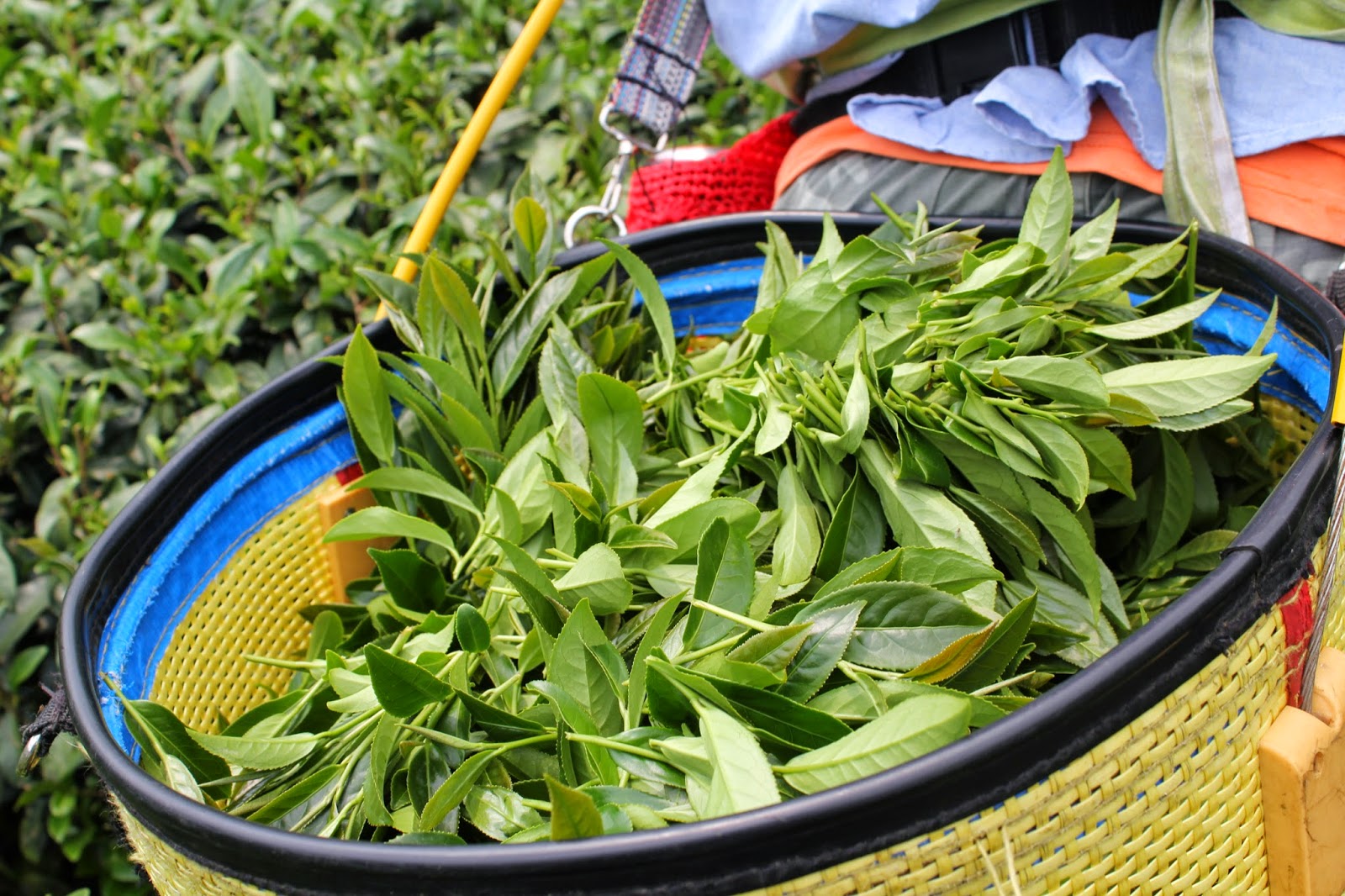
Spring Harvest Taiwan 2014


This spring in Taiwan it was raining for the high mountain tea harvest in the highest elevations. Li Shan proper and Li Shan's Da Yu Ling had rain throughout most of the harvest season.
Rainy weather is not suitable for picking and processing tea. Not because people don't want to stand in the rain and pick tea, but because for the most part, the results are subpar; too bitter. Some farmers went ahead and picked tea anyway, but we haven't been able to find any that we are satisfied with. For the most part we will not be buying high mountain tea from Taiwan this spring.
At harvest time, rain is a constant threat, especially in the Spring. Spring tea starts growing in the coldest part of winter, thus it grows very slowly. Slow growing tea results in a thicker leaf. Conditions are ideal and the result is high quality tea. The main threat to spring tea is that at harvest time, there is more chance of rain.

Some of our farming friends that have more experience decided not to pick this spring, instead they will wait until the rains stop and use the leaf to make high mountain black tea. Many of you have tried our Li Shan black tea. It is exceptionally sweet, fragrant, and delicious. Sweeter than most black tea, people often do not believe that it is just tea with no sweetener added. If you want to try some amazing black tea, we wholeheartedly recommend our Li Shan Black 2008 and 2009.

Thursday, May 29, 2014

A Short History of the Tea-bike


J-TEA’s vision, a bicycle built by CAT, and a cart transformation by GORM

What was the original vision for the tea bike cart? The vision for the bike came around the idea of having fun in the moment, or working in a way that allows us the most enjoyment of life. By being at the festivals, and street fairs, we are living our dream as a college student. The vision was really about being able to participate in the fun of working by working in the places that are fun to be. That way, at least if we want to have a good time, we are already at the party, and tea at a party is... well, a party. At J-TEA, we bring tea to the party.

And in the name of “Party!” we are now parking the tea-bike in The Healthy Pet parking lot, former home to Party Cart. However, we will not have the same geographic footprint as the iconic and legendary food cart that was the best thing that happened to the neighborhood since it was named after the iconic and brilliant Sam H. Friendly, Eugene's 12th mayor (1893-1895). A little bit close to home, you might gripe. Well I tell you, loading and riding that tea-bike all over town is no joke. Talk about ultimate fitness! You work the legs and cardio on the way to and from the selling location, and you get an upper arm workout from shaking iced tea. It's basically the entrepreneur’s workout plan. No time to leave the office and take care of your general level of fitness... thank you tea bike! Problem solved.

“CAT” stands for Center for Appropriate Transport and their method of transport is appropriate. CAT is known for their hand-built Tri-hauler cargo bikes that you will see from time to time blocking the streets as you are innocently stuck behind a slow moving bike as it works its way from point A to point B. CAT is world famous and a great place to learn everything there is to know about bikes. They offer a unique membership which allows you full reign over their bicycle work stations, providing access to enough tools to build an entire bicycle from the ground up. When it comes to specialized cargo bikes, CAT builds each bike by order. For J-Tea, they built a yellow Tri-hauler. Once I had the bike, I knew I had a start, but to get to the tea-bike, there was a long way to go.

Enter GORM, the husband and wife design team established in 2007. Jon Arndt and Won Hee came up with the name for their company as part of an inside joke. Won Hee had a copy of Matilda from Rauld Dahl. Won Hee asked John about the meaning of a word used by Rauld. "What is gormless?" John didn't know, so they turned to Won Hee's electronic Korean / English translator. It meant slow; dim witted; not bright. And so to them gorm was incorporated into their lexicon as the opposite of gormless. They started to use the word to describe things that they saw which were sharp. Their style is minimal and their focus is utilitarian, and so we got a custom made dream tea-bike. More of Studio Gorm's objects can be found here: Studio Gorm's Object Page.

So far, the bike has sold its frosty frothy iced tea at the Bite of Eugene, Whiteaker Block Party, UO Street Faire, and Eugene Sunday Streets. As we mentioned, we will soon act as a beacon to the parched as they follow the flow of West 28th Avenue as it curves around Healthy Pet's parking lot in the foothills of South Eugene.


Wednesday, May 21, 2014

Tea Caddy

Today was a cool day at J-Tea! We'd recently received a request for some detailed photos of the older well made tea caddies in the tea shop. The first caddy, a modern approach, was made for the Japanese market but manufactured in China in the 1950s.


This second piece, more traditional, was reportedly manufactured in Japan with high grade pewter in the 1940's. 


But the best part of the day was that we needed some amazing photos of this beautiful tea ware. Andrew took these photos while I was enjoying a conversation with an interesting customer. I love it when the tea house works well.